The Bedtime Hustle: How to Win the Stay-in-Bed Game
The Bedtime Hustle: How to Win the Stay-in-Bed Game

This post contains affiliate links. As an Amazon Associate, I earn from qualifying purchases.
If your kids are anything like ours, they will do whatever it takes to stay awake at bedtime.
“Mom, my water is all gone!”
“Will you cover me up again?”
“I’m still hungry!”
“I’m not tired!”
“Can I tell you something?”
I literally get surges of frustration when I hear their bedroom door open for the 10th time. Evening time is precious to me. As a stay-at-home mom, I am on the clock from 7 when they wake up to whenever they go to bed. In our ideal world, that time is 7:30. But summer is here and we find it creeping closer to 9 many nights. Which means 9-10 is my only free time to spend on my own or with my husband. One hour. And if I hear the bedroom door open during my ONE HOUR, I’m not always the mom I want to be. I knew something needed to change, so I researched and brainstormed to come up with some solutions. Hopefully one will work for you as it has for us.
- The Hatch game
- Our kid’s have a hatch night light and I wish I had bought one sooner. You can set it on a schedule for it to turn certain colors at the times you need it to. For example, ours turns green after 6:30 A.M., signaling to the kids that it is okay to come out of their room. If they wake before that, they are welcome to read a book in their bed or play quietly in their room. My kids LOVE choosing the color of nightlight at bedtime. They share a room and are each assigned days that they can choose the color. Our bedtime routine ends with them picking a color and turning the light up to 100%. They are free to chat in their room or read books (no toys). If they come out of their rooms or are being too rowdy in their rooms, the light goes down to 50%. On the second offense, it goes down to 25% and they are given a warning that if it happens again it goes all the way off. And then the follow through is extremely important, even if there is a meltdown. Your child needs to know that you mean what you say and there are consequences for their actions, even if they will cry that the light goes all the way off. It may take a few nights for a child to recognize the pattern of their actions of coming out of their room to the consequences of the light going off, but they will.
- Bedtime Passes
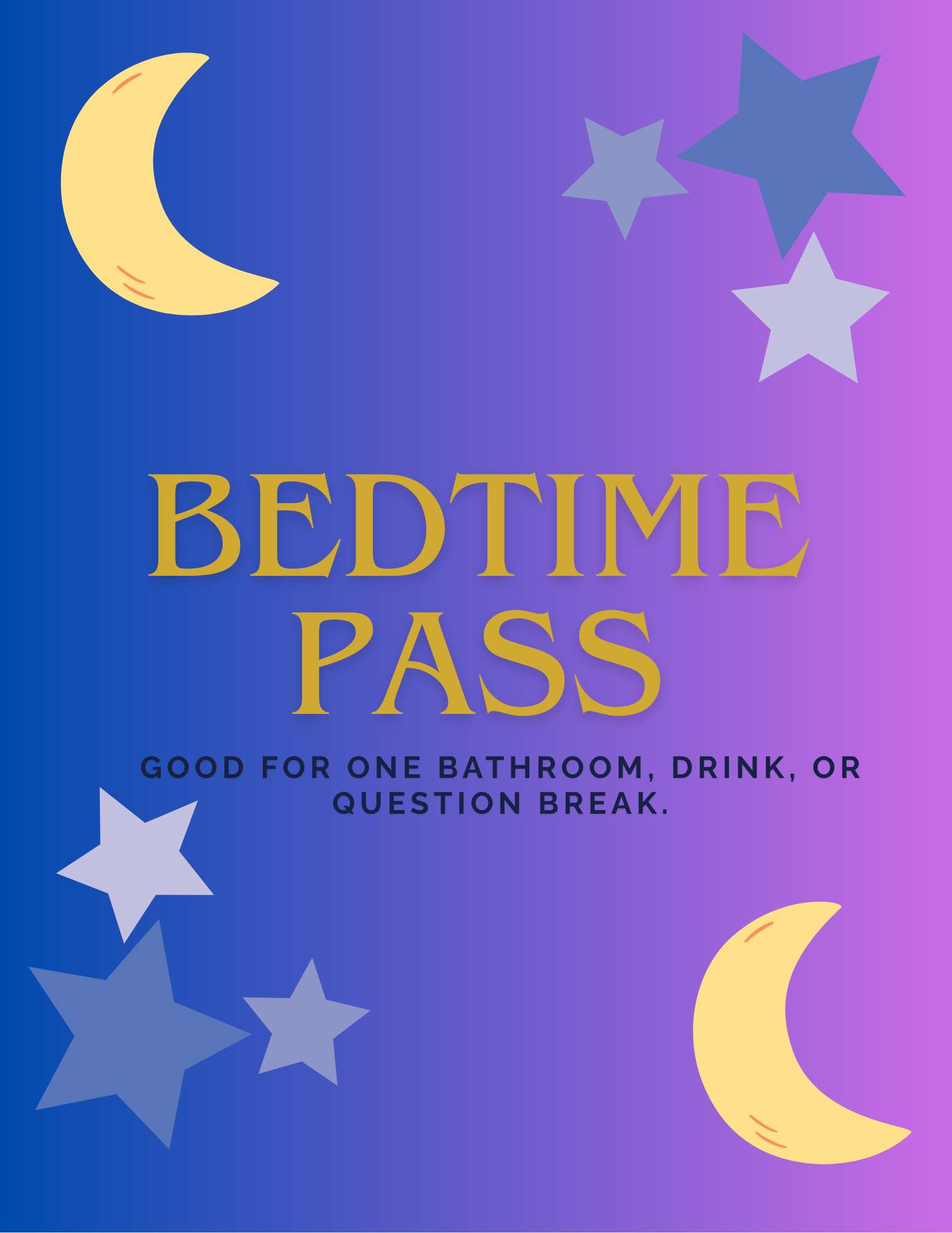
- This one could have pros and cons, so you will have to weigh these for yourself. The idea with bedtime passes is the child will have one or two passes (up to your discretion) that are laminated and in their bed with them. These passes can be used to come out of their room for a drink, a hug, a question, a bathroom break, whatever they may need. If they use it, that is it for the night. If they don’t use it, they can cash it in for something special in the morning. Maybe they get to choose what is for breakfast (from options you give). Maybe they get to pick a sticker, a temporary tattoo, or a tinker toy. Maybe they get a handful of chocolate chips or some candy. Something small you can use to motivate them. This will work great for some kids and not so much for others, so it depends on the child. One of the drawbacks to this method is if your child is extremely motivated by rewards (we have one like this) they may not go to the bathroom when they really need to. If you are potty training at night or have a child who won’t go when they should, this method might not be for you. If you want to try this method, you can download the bedtime pass below!

3. Have a routine
- Studies consistently show that kids who have routines are better able to regulate their behavior. If you have a predictable schedule, it is easier for them to know what is coming next and be ready for it. My husband and I got extremely tired of repeating ourselves for the kids to go brush their teeth and telling them what comes next. So we had the idea to make a visual guide, laminate it, and put it in the bathroom for the kids to follow. They have enjoyed having a sense of independence about getting ready for bed and not being told what to do. Here is an example of what ours looks like. It is very simple to make in Canva, or just draw one up on a piece of paper! It doesn’t have to be pretty, just functional. My kids don’t know how to read yet, so their sheet is all pictures with a column for each kid to check off. Every night my husband and I say, “Go do your bedtime routine!” And they head upstairs, use the bathroom, brush their teeth, and get jammies and pull ups on. Then they pick a book to take to bed with them, get their allowance if they completed their chores for the day, and they come to get us. It has taken a mental load off of us as parents to not repeat ourselves or ask them what has been done already.

4. Be Consistent
My last piece of advice is just to be consistent. If you say it’s time for bed and then let the kids do whatever they want until you are eventually so frustrated but aren’t really enforcing any consequences, they will learn that mom and dad don’t really mean it. And it will be even harder to break that belief in the future. Follow through on what you say. If you say it is time for bedtime routine and they continue playing, end their game. Help them walk upstairs and get started on the first task. We will often try to motivate our kids to get their bedtime routine done efficiently by offering a family game if they are done by a certain time. Do what is best for your family, but make sure you are getting some “you” time in the evenings. I believe it makes a world of difference in parenting little ones.